


Understanding
Film grain: what you see and what the emulsion makes
Film grain is not dust added after a photograph. It originates in the structure of the light-recording material and the way that structure becomes a visible image. What we casually call grain also depends on printing, magnification and viewing distance. Separating those levels prevents confusion between an emulsion, a process and a presentation effect.
Remember this
Distinguish crystals in unexposed film, the developed image structure and the sensation of grain in a print. ISO or a film name alone cannot predict that sensation. The result belongs to the complete exposure–development–enlargement chain.
Unexposed film contains light-sensitive crystals
A conventional photographic emulsion contains silver-halide crystals dispersed in a matrix, usually gelatin, carried on a support. These crystals respond to light. They are not yet the black dots we notice in an enlarged print: material before exposure and development is in a different state.
An emulsion need not be one layer of identical grains. Manufacturing arranges populations and layers for particular photographic properties. Shape, size, distribution and sensitisation work together. Reducing a film to large grains and old technology overlooks this material design, and cannot explain the range of available image structures.
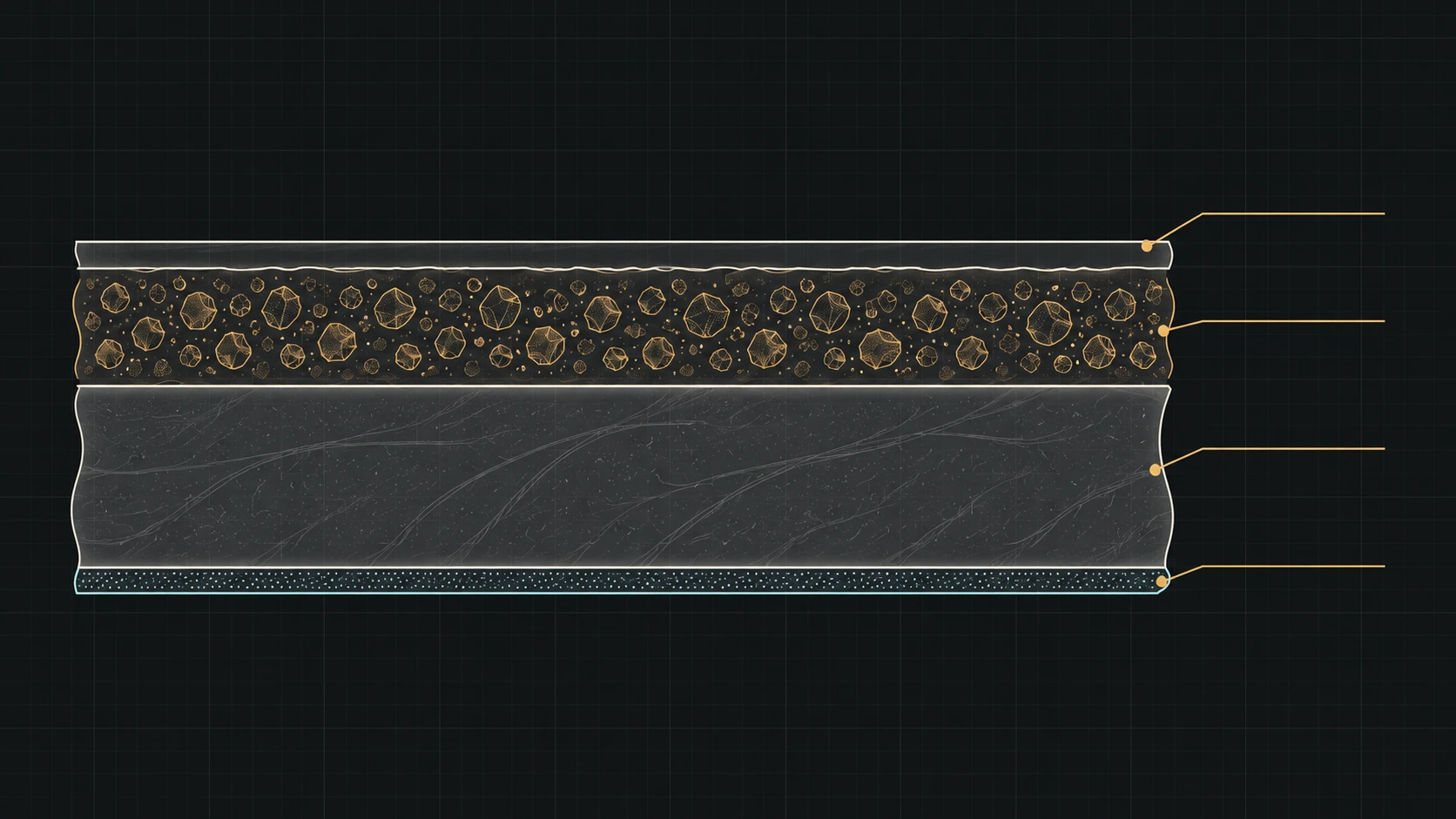
The accompanying section distinguishes protection, emulsion, base and backing only to explain their roles. Its thicknesses do not describe a commercial formula. A photograph of a roll documents an object; a conceptual section explains its organisation. Neither measures the microscopic dimensions of every crystal.
Light records an image the eye cannot yet see
During exposure, absorbed light triggers very small changes in sensitive grains. This creates an invisible latent image. It explains why exposed film still looks unchanged inside its cartridge: the subject is not yet a visible image for inspection, and opening the film to light can fog it.
Development amplifies that record. In conventional black-and-white processing, developer preferentially converts exposed grains into metallic silver. Fixation removes undeveloped halides, and washing removes processing residues. The finished negative is therefore not an unchanged inventory of crystals from the original unexposed material.
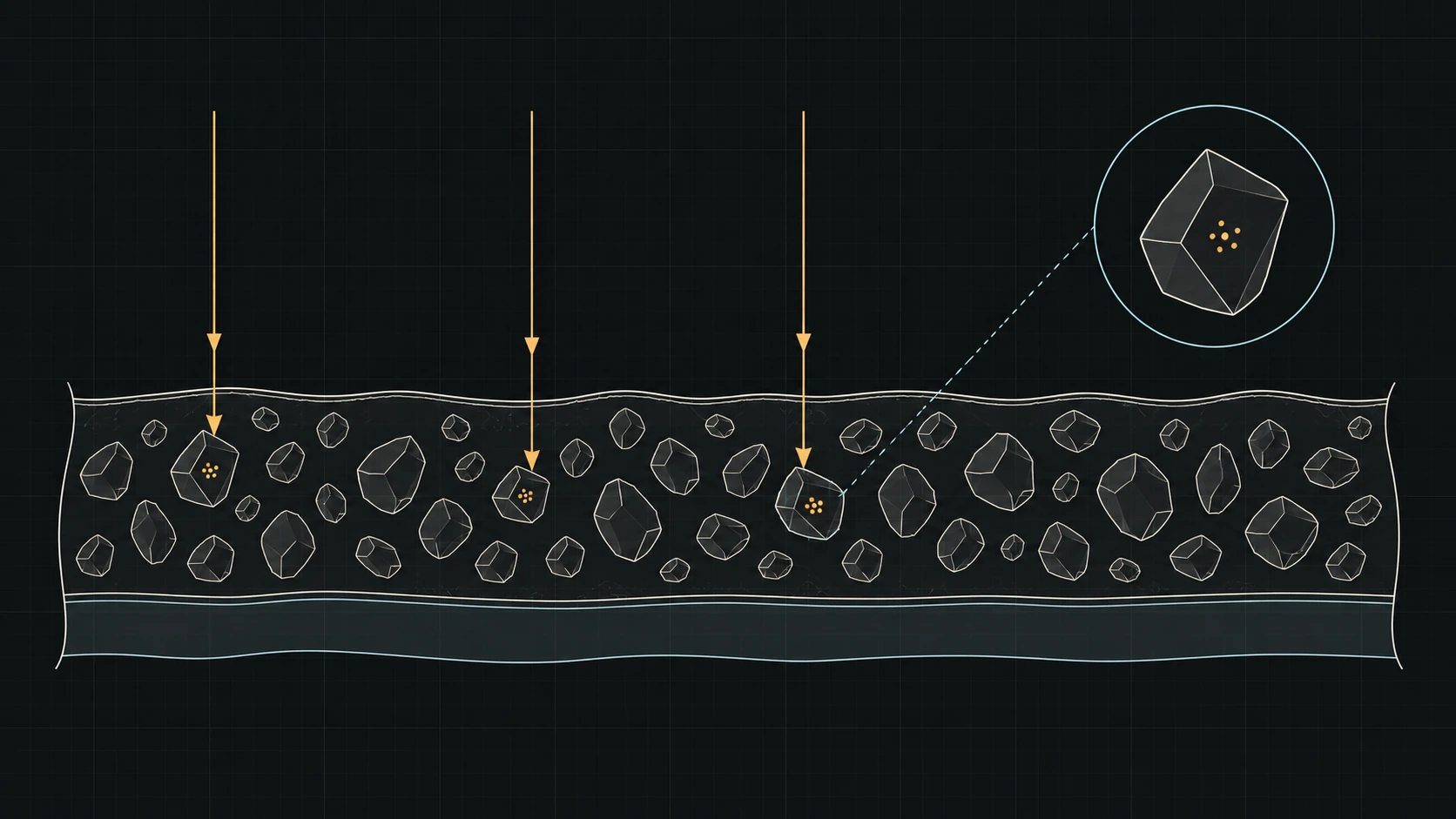
Keep that distinction in mind when reading a grain diagram. Enlarged dots can explain a mechanism, but cannot establish particle dimensions or prove that neighbouring grains physically merge. Light and chemical transformations explain the principle without inventing visible atoms or numerical precision unsupported by the drawing.
Visible grain is not a portrait of every crystal
Granularity describes measured density fluctuations under specified conditions; graininess describes the visual impression of an irregular structure. They are related but not interchangeable. Perception depends on magnification, viewing distance and contrast as well as the material, so a laboratory value is not the complete viewing experience.
In a conventional silver black-and-white photograph, developed silver forms the visible structure. In many colour processes, the finished image is largely dye-based, while the silver involved in forming it is removed during processing. Calling both grain does not make their final image-forming substances chemically identical.


A scan can reveal structure but also involves reproduction choices. The T-MAX illustration here is a documented scan of a uniformly exposed negative, not an electron micrograph. It is a real material example, but displayed website pixels cannot be used to calculate its crystal dimensions.
Sensitivity and development form a compromise
A film’s sensitivity relates to the construction of its light-sensitive material, but ISO is not a universal grain-size control. Emulsions with the same sensitivity can show different textures. Exposure, tonal reproduction and viewing conditions also affect the impression. Comparing boxes alone cannot separate those influences.
Developer and processing affect the balance of usable sensitivity, contrast, texture and apparent sharpness. Manufacturers offer different products because one result does not suit every practice. A comparison needs dilution, temperature, time and agitation rather than treating a developer’s name as a complete signature.

Push processing addresses particular exposure and development choices and may increase contrast and the prominence of texture. It cannot manufacture unrecorded shadow detail. The TRI-X sample here documents a surface and its scan; it is not a calibrated comparison with the T-MAX sample, and no quality ranking is inferred.
Enlargement changes what we call fine
A small and a large image from the same negative do not reveal its material equally. For the same output dimensions, a larger negative requires less magnification. Texture may become less evident, but medium format is not automatically grainless: emulsion, exposure and processing still contribute.
Kodak’s Print Grain Index documentation specifies print and viewing conditions. A value associated with one format and enlargement should not be moved casually to another result. Remove a number from its caption and the very conditions that give it meaning disappear.
Judge a print at its intended viewing distance before moving closer. Separate subject legibility, tonal transitions and texture. Visible grain can coexist with a sharp-looking image, while a smooth surface may lack detail. Seeking only uniformity can distract from the photograph itself.
Compare to make a choice, not find a universal winner
A useful personal test keeps scene, illumination, framing, recorded exposure, documented processing and output size as consistent as possible. Examine smooth areas and fine detail alongside midtones and shadows. This reading method helps explain your results without presenting a home comparison as an industrial measurement.
Then separate film structure from reproduction artefacts. Dust, scratches, excessive sharpening or reading noise are not a new emulsion. For an analogue original, examining the negative remains the starting point. A print or scan may emphasise particular features without describing the entire character of a film.
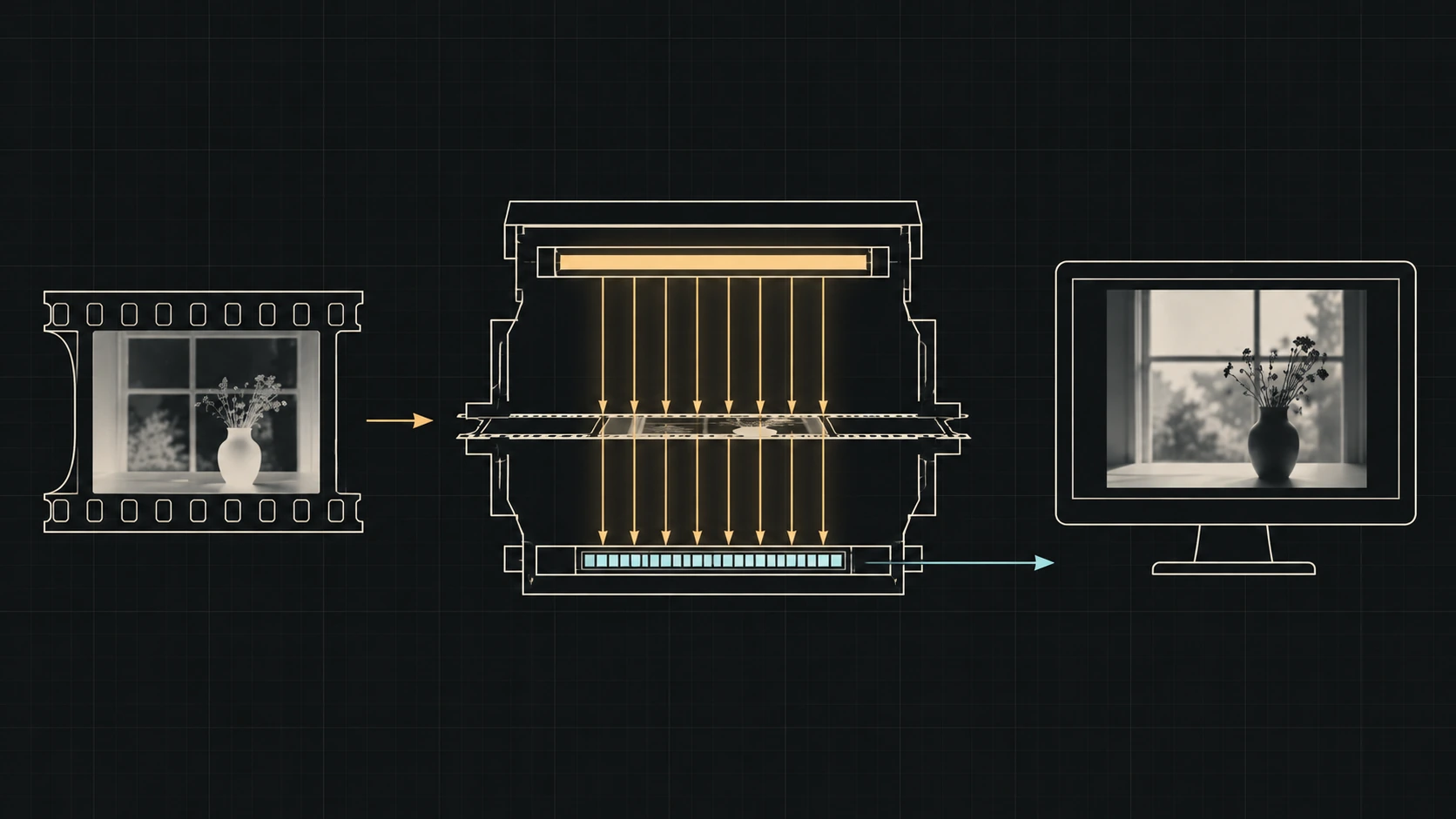
The better question is which texture helps this photograph. A quiet sky, portrait and street scene may call for different choices. Selecting film connects material, light and intention, rather than winning a contest for invisible grain. Understanding structure lets us value texture without calling it either a defect or a miracle.
Why can underexposed shadows look grainier?
In lightly exposed shadows, the more sensitive grain populations contribute more strongly to the image. Kodak explains why graininess can become more noticeable there. This does not mean that every shadow automatically contains more visible grain, or that developed particles grow when a brightness slider is moved.
Strongly lifting those tones during reproduction can reveal their irregularities. Scanner noise or noise from the camera used to reproduce the negative may add to the result. Film texture and reproduction noise can overlap; a heavily enlarged screenshot cannot reliably separate them without other evidence.
Compare similar-density areas at the same size with moderate sharpening. Examine the negative and a more neutral reproduction before blaming the stock. Appropriate exposure and documented processing provide a better starting point than attempting to recover unrecorded information through an extreme shadow lift.
Sources and further reading
- Kodak — The Essential Reference Guide for Filmmakers, Film Structure and Graininess/Granularity
- ILFORD Photo — Introduction to Film Developers
- ILFORD Photo — Processing Your First Black & White Film
- Kodak Alaris — KODAK PROFESSIONAL PORTRA 400, E-4050
- ILFORD Photo — HP5 PLUS 35 mm
- Kodak Research Laboratories — The Relationship Between the Granularity and Graininess of Developed Photographic Materials, JOSA (1945)
- Wikimedia Commons — T-MAX 100 grain sample, documented capture and scan
- Wikimedia Commons — TRI-X 400 grain sample, documented capture and scan
From reading to making images
Explore filmsKeep exploring
All stories
Halation: why bright lights spill across film
Reflected light, anti-halation layers and red halos: understand remjet, AHU and the differences between film halation and optical glow.
Read the story
Glow and bloom: where do soft highlights come from?
Diffusion, contrast, flare and focus: understand why lights seem to radiate and how to control the effect without losing the subject.
Read the storyShare this article
An idea worth passing on.