



Histories
Ilford: a century and a half of black-and-white dedication
Founded in 1879 by Alfred Harman in the basement of his home in Ilford under the name Britannia Works, the British brand has stood as the global sanctuary of black-and-white photography. While the entire photographic industry rushed toward color and subsequently digital sensors, the Mobberley factory chose to relentlessly refine the chemistry of silver halides.
Remember this
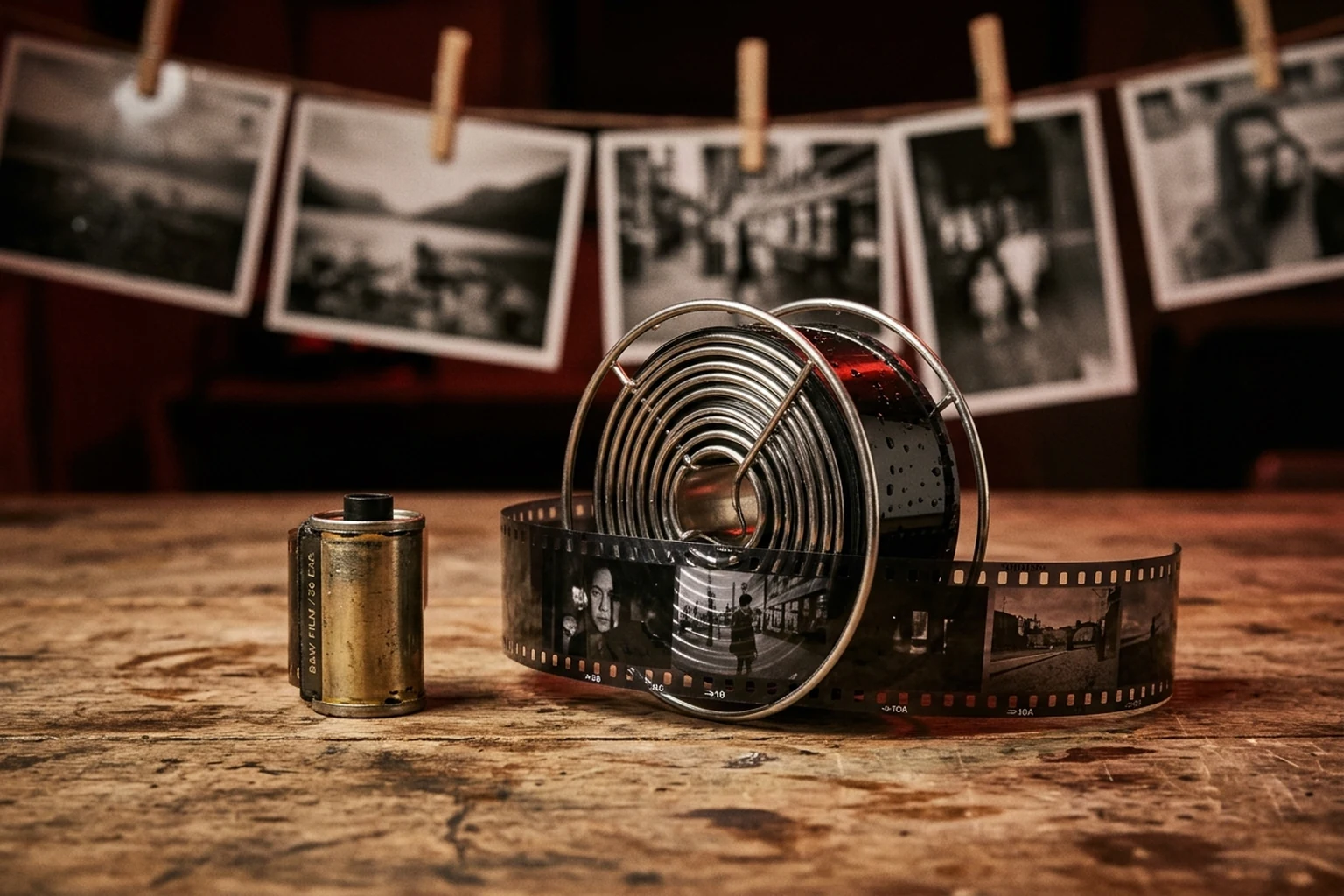
Ilford's enduring supremacy rests on the masterful coexistence of two distinct emulsion architectures: traditional cubic grain emulsions like HP5 Plus and advanced tabular Core-Shell technology in the Delta range, anchored by the historic invention of Multigrade variable contrast paper.
1879: Alfred Harman and Gelatin-Bromide Dry Plates
The journey began in Essex when photographer Alfred Harman set out to manufacture his own silver gelatin-bromide dry plates. At a time when practitioners still had to prepare wet collodion coatings in field tents minutes before exposure, factory standardization of ready-to-use dry plates represented a monumental leap forward.

Harman perfected the precipitation of silver salts inside purified animal gelatin, ensuring unprecedented batch-to-batch sensitivity. The venture, initially named Britannia Works, quickly adopted the town name of Ilford to sign products whose reputation rapidly crossed the British Empire.
This initial rigor forged the brand's lasting philosophy: rather than pursuing fleeting patents, Ilford invested heavily in chemical purity and manufacturing consistency, creating an enduring benchmark of quality.
Mobberley: The Strategic Move to Cheshire's Pure Air
In 1902, facing growing industrial smoke in London that risked contaminating fresh emulsion coatings with airborne soot, the manufacturing plant relocated to Mobberley in rural Cheshire. This geographical move was essential: clean air and exceptional water quality were crucial for thorough silver washing.

At this expansive site, Ilford constructed coating and drying tunnels several hundred meters long, operating in complete darkness or under precisely calibrated amber safelights. Each film base receives successive layers with sub-micron tolerance.
To this day, Mobberley remains the only Western industrial facility capable of synthesizing its own polymers, casting black-and-white emulsions, and packaging roll film and photographic paper under one roof without outsourcing.
1940: The Multigrade Paper Revolution
Prior to 1940, darkroom printers had to maintain bulky stocks of fixed-grade papers (from grade 0 for contrasty negatives to grade 5 for flat negatives), risking waste and incurring significant costs. By introducing Multigrade variable contrast paper, Ilford revolutionized darkroom printing forever.

The innovation blends two or three distinct emulsion layers: one is low contrast and sensitized to green light, while the other is high contrast and sensitive solely to blue light. By altering the projection color via yellow or magenta filters on the enlarger, the printer fine-tunes contrast across fractional grades.
This invention liberated darkroom artists, allowing them to selectively dodge shadow areas with soft filtration while burning highlights with hard filtration on a single sheet of fiber-based paper.
HP5 Plus vs Delta: Two Philosophies of Grain
In its negative film lineup, Ilford deliberately maintains two divergent physical and aesthetic philosophies. HP5 Plus 400 is the direct heir to traditional cubic emulsions: its silver bromide crystals vary in size and geometry, producing an organic, gritty grain and immense exposure latitude that forgives metering errors.
In contrast, the Delta range (100, 400, and 3200) embodies cutting-edge tabular crystal technology featuring a Core-Shell architecture. The crystal core is iodide-doped to maximize photon capture, while the outer bromide shell ensures rapid, clean chemical reduction.
This flat tabular geometry provides maximum light-collection surface for a reduced silver volume, yielding tack-sharp acutance, crisp micro-contrast, and remarkably modern midtone gradation.
Darkroom Alchemy: ID-11, Microphen, and Ilfotec DD-X
A photographic emulsion is only as good as the developer that reveals it. In the 1930s, Ilford standardized ID-11, an industry-standard formula combining metol, hydroquinone, and a high sodium sulfite concentration that acts as a gentle silver solvent to soften grain edges.
For low-light shooting and push processing, Mobberley chemists formulated Microphen, based on Phenidone, capable of boosting film speed by one to two stops without blocking shadow details or causing excessive grain clumping in open skies.
With the introduction of modern Delta films, Ilford developed Ilfotec DD-X, a liquid concentrate engineered to complement tabular crystal sensitometry, delivering seamless gray transitions from Zone I to Zone X.
Silver Resilience and the Harman Technology Renaissance
In the early 2000s, the digital revolution plunged traditional film manufacturers into an unprecedented crisis. When the parent company went into administration in 2004, six senior Mobberley managers refused to see the plant close and mounted a management buyout under the name Harman Technology, honoring the founder.
Their conviction was visionary: rather than pursuing fleeting consumer digital sensors, they established Ilford as an impregnable fortress of traditional silver craftsmanship. The plant modernized its lines, maintained large-format sheet cutting, and supported the global analog community.
Today, Mobberley operates at full capacity, shipping films to over 80 countries and proving that silver-gelatin emulsion, with its distinct tactile texture and physical permanence, remains an irreplaceable artistic medium.
Sources and further reading
About this article
Written with the assistance of Codex and Astra, using the cited sources. The diagrams are educational; documentary photographs retain their authors and licences.
From reading to making images
Explore filmsKeep exploring
All stories
Developing your first black-and-white film, step by step
Tank, reel, developer and fixer: understand every stage of film processing without relying on a universal recipe.
Read the story
Film grain: what you see and what the emulsion makes
Light-sensitive crystals, developed silver, dyes and enlargement: understand grain without treating it as a simple defect.
Read the storyShare this article
An idea worth passing on.