
In the darkroom
Soft or hard light: what distance really changes
Bring a large source closer and shadow edges often become more gradual. Yet the background can darken and the face remain strongly contrasted. There is no contradiction: edge softness, direction and the distribution of illumination describe different properties. Distance affects several at once.

Remember this
The angular size of the source as seen from the subject largely governs shadow softness. Soft does not mean weak or low-contrast. The inverse-square law is exact within its point-source model; close to a large luminous surface, it requires care.
The source is large… from whose viewpoint?
The dimensions printed on a softbox do not fully describe its effect. Light reaches the subject from a range of directions: this is the apparent, or angular, size of the luminous surface seen from the subject. With comparable shape and orientation, a nearby source occupies a larger angle than the same source farther away.
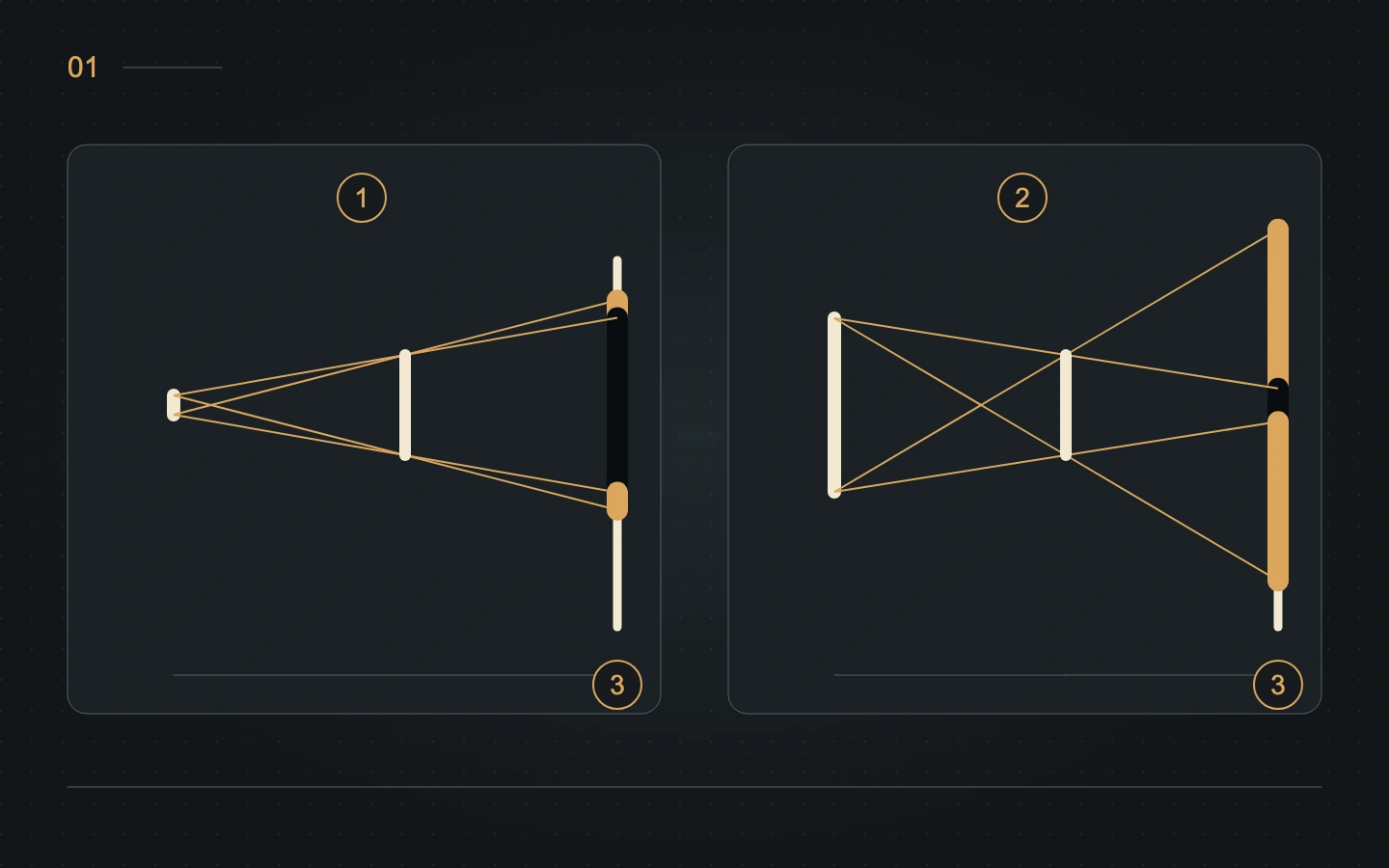
Near a shadow edge, part of an extended source may remain visible while the rest is hidden by the object. That transition is a penumbra. A source with a small angular extent tends to make a narrower transition. The distance between the object and the receiving surface matters too: a contact shadow can remain sharp beneath a large source.
To observe this, place a matte object at a fixed distance from a background and move a reasonably broad luminous surface. First examine the shadow edge rather than overall brightness. This is a suggested exercise with no claimed numerical result. Our diagrams simplify the geometry and assume the indicated surface actually emits light throughout.
Softness does not determine contrast by itself
Softness chiefly describes the transition at shadow edges. Contrast between a lit face and a dark face also depends on the light reaching the latter. A broad side window can produce gentle transitions and a strong brightness difference if the room returns little light to the opposite side.
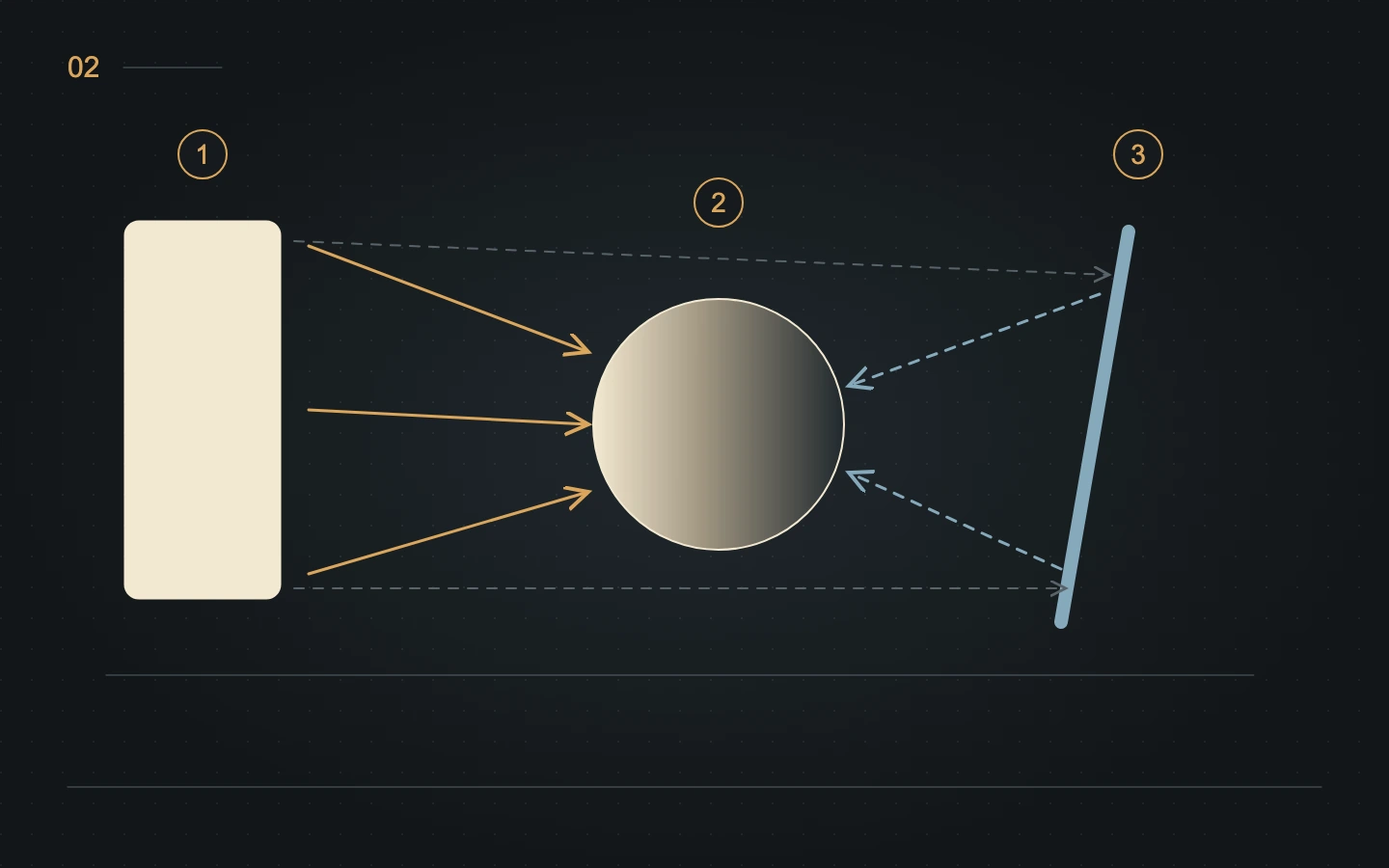
Conversely, a small source can cast crisp shadows while ambient or reflected light brightens the dark areas. A pale wall or reflector can fill those areas without directly enlarging the key light. A black panel can reduce some reflected contributions. These changes concern fill and the surrounding space, rather than a magical change in the diffuser.
Direction is a separate choice. Moving light sideways changes which surfaces it reaches, their reflections and modelling; bringing it closer along the same axis changes other relationships. No position is universally flattering. For a portrait, decide which details and mood matter, then inspect the face and the background separately.
Distance changes relative differences
For a point source with a given luminous intensity, illuminance on a surface perpendicular to its rays varies inversely with distance squared. Doubling the distance gives one quarter of the illuminance, or two stops less, in this model. The relevant emission direction must remain the same; tilting the receiving surface adds an angular dependency.
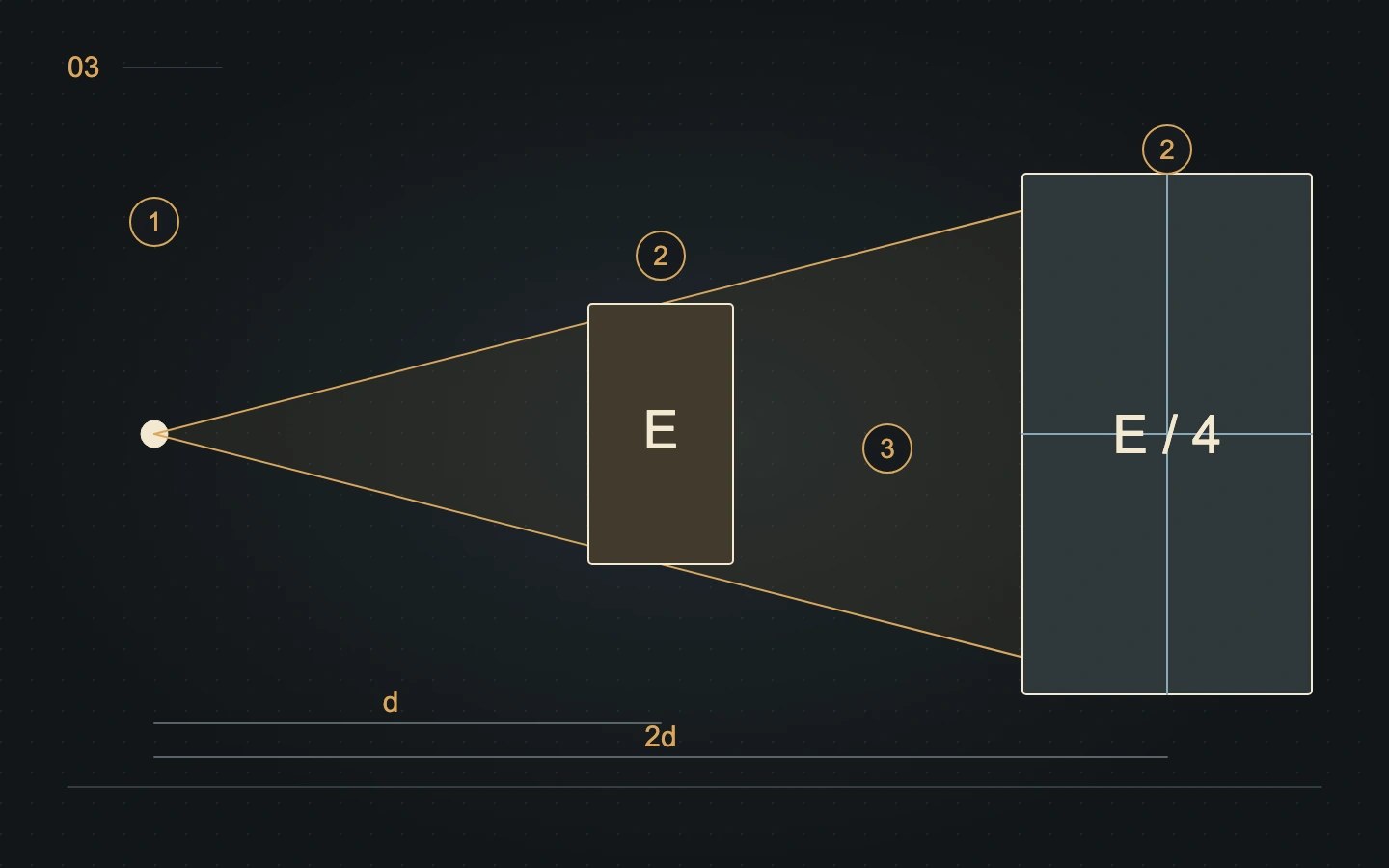
Consider a calculation rather than a flash measurement: a surface two metres away receives a quarter of the illuminance at one metre. Between four and five metres, however, the ratio is sixteen twenty-fifths, or 0.64. An extra metre therefore has a different relative effect depending on the starting position. This relationship helps explain subject-to-background differences.
If the source is moved farther away and its output increased to maintain subject exposure, a background slightly behind the subject can become relatively brighter in this model. Without compensation, the whole scene may simply darken. Always separate absolute change from the subject-to-background ratio. The diagram's numbers are idealised calculations, not readings from equipment.
A large nearby source is not a point
Close to a large softbox, each portion of the diffuser is at a different distance and angle to the subject. Their contributions are added together; replacing everything with a central point can give a poor estimate. The IES defines the approximation's domain for finite sources, while PBRT's area-light description explains why the calculation depends on the emitting surface.
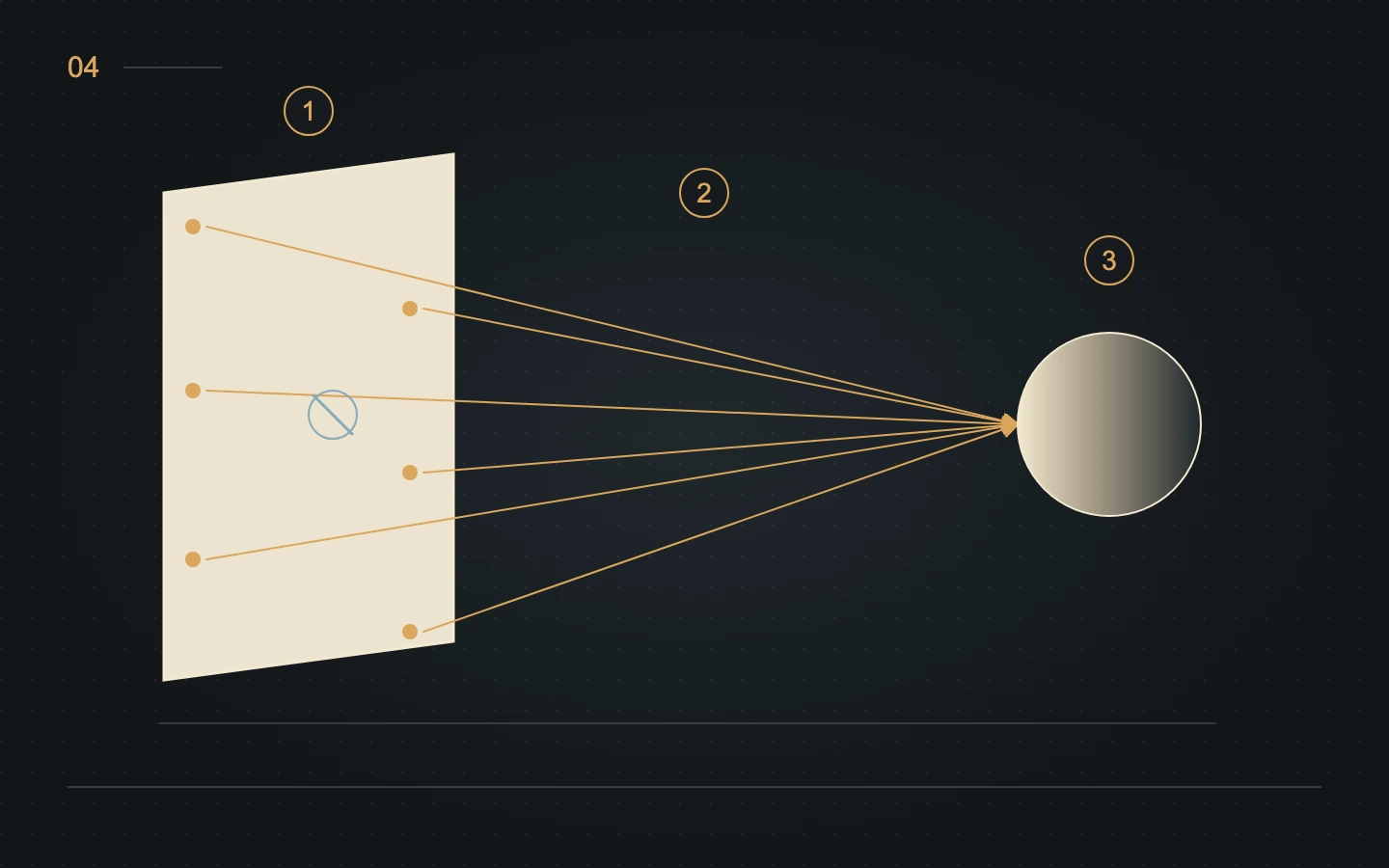
Inverse-square reasoning remains useful when a source is sufficiently small relative to its distance, under appropriate conditions. It does not justify predicting exactly two stops every time a large nearby window, panel or umbrella changes distance by a factor of two. Orientation, emission distribution, accessories and room reflections affect the actual result.
In practice, place the source for the geometry you want, then check exposure with a meter, image inspection or consistent trials. Exposure compensation cannot restore the apparent size lost when moving the source away. Keeping similar softness at a greater distance may require a larger luminous surface, depending on the setup.
Diffusing, moving closer and changing direction
Diffusion material can redistribute light, but a luminous surface that still appears small to the subject does not automatically become a broad source. Check which part of the fabric is actually illuminated. A large screen lit only at its centre can behave differently from the same screen lit evenly. Effective geometry tells you more than an accessory's name.
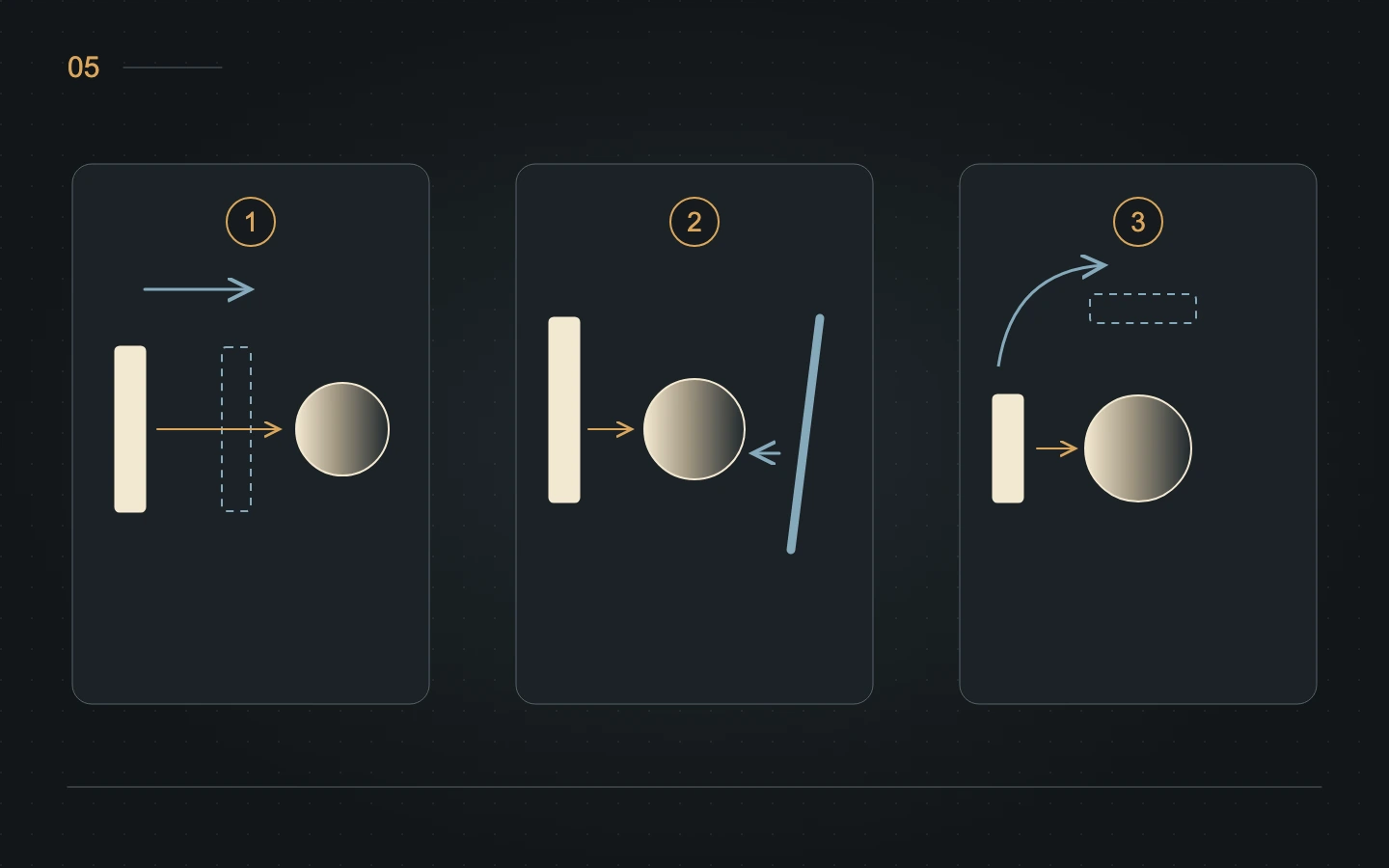
Start with a stationary object and change one factor at a time. Compare the same source near and far, adjusting subject exposure to examine softness. Keep its position and add a reflector to study shadow brightness. Finally move the source around the subject to explore direction. Record changes rather than presenting these images as universal measurements.
A narrow strip source can also produce different softness along differently oriented edges. Reflections sometimes reveal source shape, but materials and specular geometry matter too. Inspect shadow edges, shadow brightness and reflections separately. This lets you choose expressive lighting without reducing each situation to a single hard-or-soft label.
Sources and further reading
- broncolor — Hard, soft and diffused light: what is the difference?
- broncolor — Famous Five: shadow definition and shadow contrast
- Illuminating Engineering Society — Inverse-square law, domaine de validité
- Pharr, Jakob, Humphreys — Physically Based Rendering, 4e édition: Area Lights
- David Hobby / Strobist — Lighting 102: Apparent Light Size, démonstration photographique
- Pharr, Jakob, Humphreys — Physically Based Rendering, 4e édition: Point Lights
About this article
Written with the assistance of Codex and Astra, using the cited sources. The diagrams are educational; documentary photographs retain their authors and licences.
From reading to making images
Explore filmsKeep exploring
All stories
Why the same colour changes under different light
Light spectra, metamerism and white balance: understand why skin, clothing or a print can change colour with the lighting.
Read the story
Glow and bloom: where do soft highlights come from?
Diffusion, contrast, flare and focus: understand why lights seem to radiate and how to control the effect without losing the subject.
Read the storyShare this article
An idea worth passing on.